
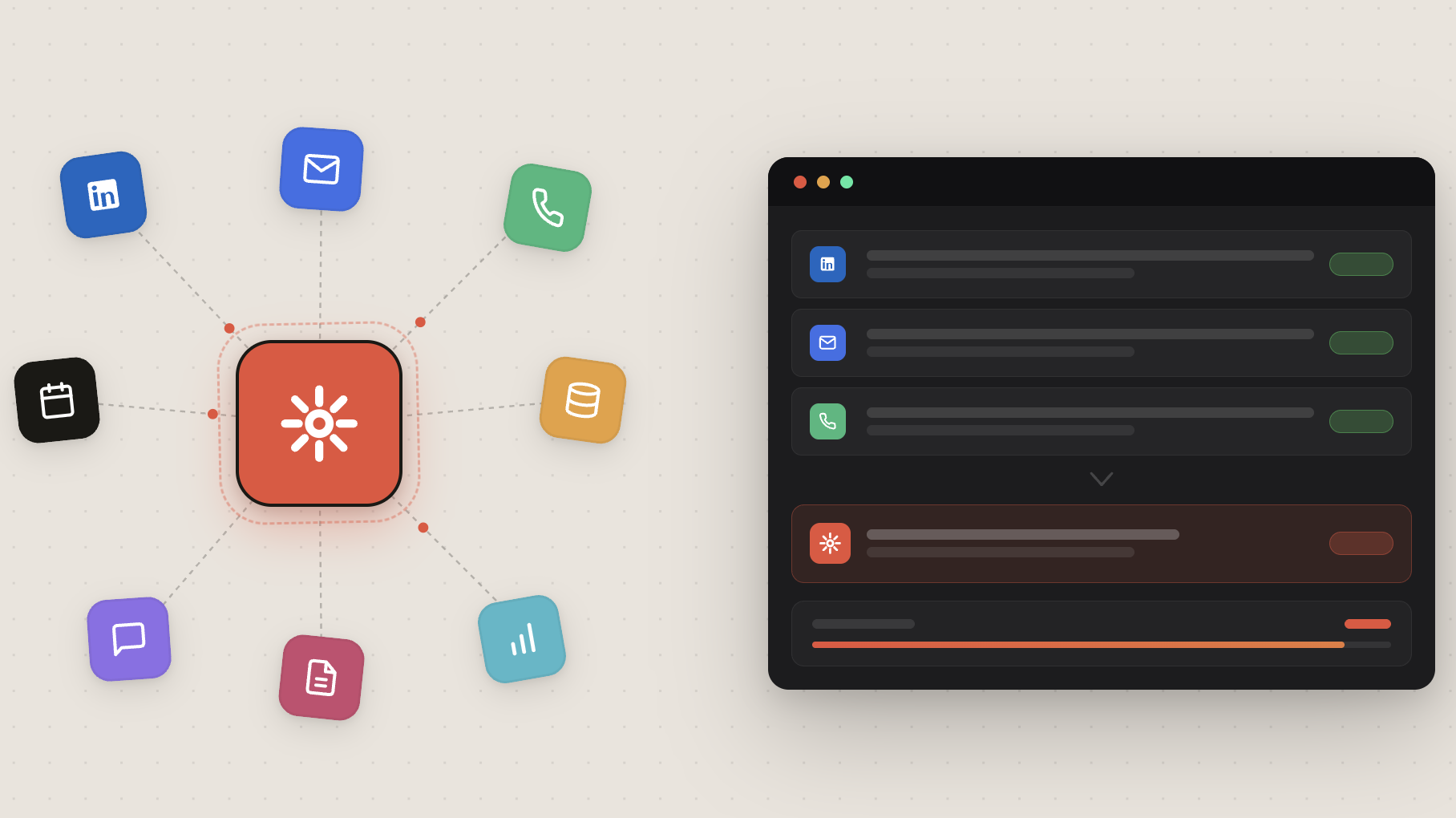
IN SHORT Sales automation within a CRM helps reduce manual tasks, centralize prospect data, and accelerate the sales cycle. Traditional CRMs like Salesforce or HubSpot are powerful, but often too complex for teams that need speed and simplicity. More focused solutions, combined with AI, are now changing the game.
Emails, Linkedin, voice messages, calls, social media… B2B prospecting has never been so fragmented. Yet most sales teams are still juggling five different tools to manage a single prospect. The result: scattered data, wasted time, and a pipeline that’s difficult to manage.
What Are We Talking About?
Sales automation refers to all the processes that allow a sales team to operate without manually executing every micro-task. In a CRM, this takes the form of workflows that automatically trigger based on a prospect’s behavior, pipeline stage, or a specific action.
A few concrete examples: a lead fills out a form on your website, their profile is automatically enriched (company, role, LinkedIn profile), then assigned to the right salesperson with a follow-up sequence triggered without human intervention. Every interaction (sent email, call tool exchange, scheduled meeting) is tracked and integrated into the contact record.
The key features of an automated CRM include:
Automated follow-ups and email sequences
Data synchronization across all channels (email, LinkedIn, phone)
Lead management and qualification
Automatic contact enrichment
Real-time pipeline tracking
The core objective is simple: free salespeople from repetitive tasks so they can focus on what truly creates value, human relationships and negotiation.
Why Centralize All Your Sales Tools?
The average B2B salesperson uses between 5 and 7 different tools daily: an email platform, Sales Navigator, a calling tool, a CRM, a note-taking app, a calendar, and more.
The issue isn’t having multiple tools. The issue is that they don’t communicate with each other.
When a Linkedin interaction isn’t logged in the CRM, when an email sent through a third-party tool isn’t synced with the contact profile, or when lead scoring is managed manually in a Google Sheet, pipeline quality suffers.
The data becomes incomplete, follow-ups happen twice or too late, and managerial visibility is almost nonexistent.
A CRM that consolidates emails, Linkedin messages, calls, and social interactions into a single interface reduces the team’s cognitive load and improves responsiveness to buying signals from prospects.
Salesforce, HubSpot… Why Some CRMs Become Overengineered
Salesforce and HubSpot are the two market leaders.
And for good reason: their feature sets are extensive, their integration ecosystems are massive, and their reporting capabilities are advanced. But these strengths are also their biggest weakness.
Deploying Salesforce in an SME or scale-up often requires several months of setup, a dedicated administrator, and a budget that quickly reaches tens of thousands of euros annually (licenses, integrations, and training included).
HubSpot is more accessible, but pricing escalates quickly once serious automation is needed.
The problem isn’t the power of these tools, it’s the effort-to-result ratio. A team of 10 sales reps doesn’t need a Formula 1 car. They need a car that starts on the first try.
Common Friction Points with Complex CRMs
Long onboarding cycles (3 to 6 months to become fully operational)
Too many integrations to maintain (Zapier, Make, custom APIs)
Partial adoption by teams who continue using spreadsheets in parallel
Workflows that require an expert to modify
Hidden costs tied to additional modules
This is the context in which we created Centra, designed to centralize the entire prospecting workflow (emails, LinkedIn, contacts, pipeline) into a single tool built for sales execution — without unnecessary complexity.
Artificial Intelligence Combined with Sales Tools
AI is no longer a gimmick in sales software.
It’s becoming the invisible infrastructure that makes automation truly intelligent. Where a traditional CRM applies fixed rules, an AI-powered CRM adapts behavior based on context.
Here’s what AI brings to sales workflows in practice:
Automatic enrichment:
from a name and email address, AI rebuilds the full prospect profile (company, industry, size, role, recent buying signals)
Predictive scoring:
models learn from won and lost deals to identify leads most likely to convert
Database analysis:
analyze your entire CRM and rethink priorities using a single prompt
Performance analysis:
identify which messages convert, the best sending times, and the most effective email subject lines
The impact is measurable: teams integrating AI into their sales stack report an average 30–40% time savings on prospecting tasks, along with significantly improved response rates thanks to better personalization.
API connections between a centralized CRM and AI models like Anthropic’s Claude or OpenAI’s ChatGPT make it possible to automate entire sequences — from prospect identification to post-demo follow-ups — without manual intervention at every step.
Which Industries Need an Automated CRM the Most?
The short answer: every industry that relies on high-volume prospecting.
But some sectors see particularly fast ROI.
SaaS Companies
Software publishers are on the front line.
Sales cycles are often short, inbound lead volume is high, and rapid qualification is critical. An automated CRM allows teams to process 3 to 5 times more leads without increasing headcount.
Consulting Firms and B2B Agencies
Sales reps often manage dozens of prospects simultaneously at different pipeline stages. Automated follow-ups and precise interaction tracking become essential. A missed opportunity left untouched for two weeks can cost a deal.
Finance and Business Services
These sectors benefit heavily from traceability: every interaction documented, every exchange archived, every decision tracked. Automation also reduces the risk of human error in regulatory follow-up processes.
Recruitment Teams
Specialized recruitment firms and hypergrowth scale-ups increasingly use sales CRMs to manage candidate sourcing. The logic is exactly the same as prospecting.
Tech Companies with Multi-Stakeholder Sales Cycles
When buying decisions involve multiple stakeholders (champions, decision-makers, CIOs, CEOs), companies need a CRM capable of tracking every contact, every interaction, and orchestrating a coordinated multichannel approach.
Conclusion: Automation Is an Investment, Not a Cost
Sales automation is no longer reserved for large enterprises with dedicated RevOps teams. It is now accessible to any organization doing B2B prospecting — provided they choose tools that match their actual needs.
Centralizing data and communication channels into a single CRM is the first step.
It creates the foundation on which automation and AI can operate effectively. Without that foundation, every tool remains an isolated island, and the promised time savings stay theoretical.
If you’re looking for a CRM capable of centralizing your prospecting through email and LinkedIn while managing your pipeline, then Centra was designed specifically for that.
SUMMARY Centralizing sales tools into a single CRM is the prerequisite for automation to truly deliver on its promises. AI accelerates this shift by making workflows smarter and personalization scalable. Teams adopting these practices today are building a structural advantage over those still juggling disconnected tools.